Watch / both
TypeSafe AI Jev vs. Laya: what they are and the controversy so far

Adam Gardner (@agardnerit) · both
Open this video on YouTubeAs of September 2026, Laya and Jev are decision-model products for software that needs typed answers instead of generated prose. Laya provides open weights that can be self-hosted under Apache 2.0. Jev is a hosted TypeSafe AI service with a published input price and no public model weights. Neither product is a general-purpose chat model.
Adam Gardner (@agardnerit) · both
Open this video on YouTubeLaya is a family of non-autoregressive System 1 decision models from Convai Innovations. Its main English checkpoint uses a 421M-parameter ModernBERT-large encoder. It accepts text, email, ticket, or JSON state and typed questions, then returns structured answers in one forward pass.
Jev is TypeSafe AI's first System One model. Software sends unstructured state and predefined questions, then receives typed answers and probabilities. It is trained with Reinforcement Learning for Calibrated Decisions and uses parallel sampling.
| Dimension | Laya | Jev |
|---|---|---|
| Primary role | Open-weight structured decision model | Hosted structured decision model |
| Output | Typed answers and probabilities | Typed answers and probabilities |
| Main public checkpoint | 421M parameters | not published |
| Other checkpoints | 322M multilingual; 421M typed-decisions | Versioned hosted model, including Jev 1.13.0 in published tests |
| Sampling approach | Non-autoregressive, single forward pass | Parallel sampling |
| License or access | Apache 2.0 weights; self-hostable | Hosted TypeSafe API; early access in reviewed sources |
| Language coverage | Model family described as covering 100+ languages; multilingual card displays 51 languages | not published as a comparable benchmark |
| Published price | No hosted Laya API price; local inference has hardware and operations costs | $0.042 per million input tokens; output listed as free |
| Latency evidence | 39.5ms for the 421M English checkpoint on a T4 | Independent published p50 measurements range from 236ms to 276ms and include hosted API latency |
| Maintenance | Convai Innovations open-source repositories and model cards | TypeSafe AI hosted service |
Alex Hitt (@alexander-hitt) · Laya
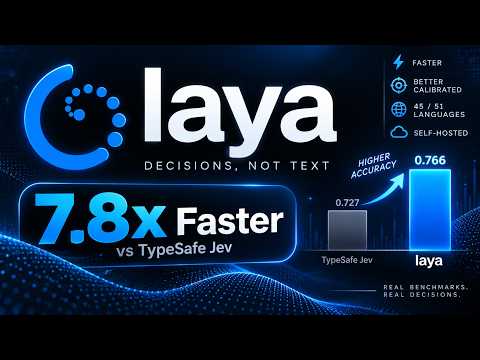
Open this video on YouTubeLaya's official typed-decisions model card reports 0.766 for its fine-tuned checkpoint and 0.727 for the published Jev 1.13.0 result. The card also states that the Jev figures were published elsewhere and that the Laya result belongs to a checkpoint fine-tuned on that benchmark's training split.
A single Reddit head-to-head post reports the opposite direction: 92.9% for Jev, 65.3% for Laya's main 421M checkpoint, and 71.1% for Laya typed-decisions. The limits matter: it was one post, the test data was generated by Fable 5.1, and the post was only a few hours old when reviewed, before community voting had settled.
The main English Laya checkpoint is documented with a 512-token context setting. In the Reddit test, Jev reportedly found a buried fact in 450 of 450 notes with inputs reaching about 4,000 tokens, while Laya degraded when the relevant fact moved beyond its available window.
This was still a single early community test using AI-generated data, not a universal context benchmark. It does show why context size, data location, and network path belong in any serious comparison.
Both systems trade free-form text generation for structured decisions. Both can support routing, classification, scoring, moderation, verification, and other workflows where software already knows the allowed answer shape. Both also require careful evaluation.
You need weights on your own machines, offline inference, Apache 2.0 licensing, or control over fine-tuning and calibration.
You prefer a managed API, do not want to operate model weights, or need a hosted decision service around predefined schemas.
Yes. The Laya model card provides Python installation and loading examples, and the weights are listed under Apache 2.0.